Article
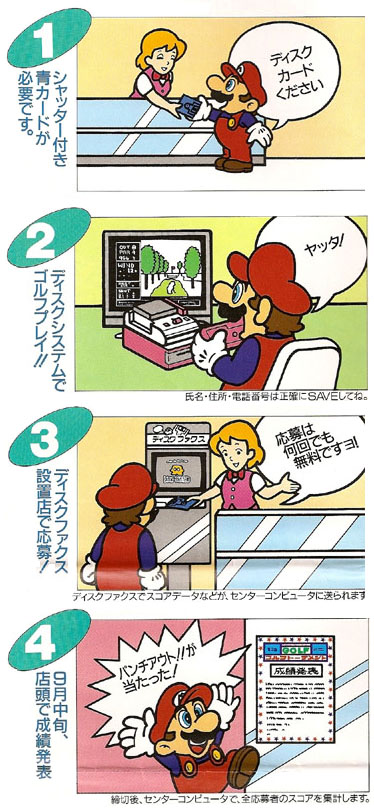
In 1987, Nintendo attempted a bold feat: It wanted to link all of Japan’s Famicoms through a complex network much like an amateur version of today’s internet. To test the network, Nintendo put on competitions, where gamers could play a Disk System video game and then have their high scores “faxed” into Nintendo’s Japan headquarters from any store that was linked to through Famicom Network System. Nintendo posted the scores on a leaders’ board at headquarters.
In fact, Nintendo held four such competitions, and by the end of each of those four competitions, the company awarded to winning gamers all of the over 50,000 prizes available. Each competition had one prize. Four of the five main prizes came in the same off-white box with a printed ribbon on it. Within each box was a yellow plastic case in the shape of Disk-kun, the Famicom mascot. What was inside each of the four Disk-kuns given out at each of the four competitions was different.
The first ever Nintendo competition was called the Nintendo Famicom Golf Tournament Japan Course, held in early 1987. At this tournament gamers were challenged to get the highest score after completing the round of golf contained on the original Disk System version of Golf Japan. The prize given to the winners was a Disk-kun in an off-white box. Inside the Disk-kun was a gold Famicom Disk System disk that included the Famicom Golf game as well as a special 19th hole available only on the prize disks. It is believed that 10,000 of these gold disks were given out, but that number is not confirmed.
In late 1987, the second competition, the Nintendo Famicom Golf Tournament U.S. Course, was held. Nearly exactly the same as the first, this time gamers were challenged to Golf U.S. The prize was also the same — the Disk-kun in a white box with a gold disk — yet this time it was the U.S. version of Golf, plus a 19th hole, that was the prize. Unlike the first competition, there was a second prize given out: the gold Punch-Out!! Special cartridge, box, and manual. This cartridge was given out in the same number as the rest of the prizes — 10,000. The top 100 scorers in this tournament received a commemorative plaque and disk card.
The first two competitions, which saw as many as 300,000 Japanese participants, purely involved Nintendo’s desire to test it’s Famicom network. It was the later two competitions that would be more closely linked to the promotion of two Disk System games and Nintendo’s desire to sell a high volume of those games.
The third competition saw some change for the two previous Golf tournaments. In 1987, Nintendo held the Nintendo Famicom Grand Prix F1 Race. In this one, gamers were challenged to the Disk System’s Grand Prix F1 Race, and the Disk-kun given out contained a special edition Game & Watch Super Mario Bros. Another item given as commemorative awards was a Grand Prix F1 Race driver’s license, which had printed on it the name of the gamer, his or her time score and rank, and the store in which the gamer submitted his or her score. This tournament coincided with the release of Grand Prix F1 Race for the Disk System and was a promotion of that game.
The fourth and final official tournament was the Nintendo Famicom Grand Prix II 3D Hot Rally. It took place in 1988 as a promotion of the release of Grand Prix II 3D Hot Rally. This tournament was much like the Nintendo Famicom Grand Prix F1 Race. This time, however, high scoring gamers got an unusual prize: an official Nintendo stationery set, again within a Disk-kun case and white box.
The four Disk-kun prizes and Punch-Out!! Special sell from anywhere between $150 and $2,650, depending on how complete they are and their condition. The Game & Watch Super Mario Bros. is highly sought after by Game & Watch collectors, making it the most expensive of the five prizes. One marketed by a seller as “brand new” sold for $2,651.
Nintendo had plans for a fifth event similar to the tournaments, this time using the Disk System game Nakayama Miho no Tokimeki High School. The point of that game was to say the right words and use the right facial expressions to convince the sexy, real-life Japanese model Miho Nakayama to give you her phone number. Nintendo did operate a telephone service that would let you talk with Nakayama — or at least some Japanese chick or recording whose voice sounded similar. It’s thought that once you got the number, you could submit it or prove you got it to receive a gift from Nakayama: a VHS tape featuring her.
Not Just Nintendo
Other notable commemorative products and prizes from gaming companies’ competitions in Japan include the relentlessly challenging Recca, given out at Summer Carnival ’92, where gamers competed to get the highest score. Namco held Namcot Summer Cup ’85, and the top 1,000 scorers got a complete set of the first 10 Namco games in a special silver case. Other competitions included Hudson Soft’s The Champion of Lode Runner and dB Soft’s Flappy tournament, the latter ranking you by prize cards: “The Blue Star Prize,” “The Flappy Prize,” “The Unicorn Prize,” and “The Ebeelor Prize.”
Also, a Disk System game called All Night Nippon Super Mario Bros. was given out by the radio station All Night Nippon. The game includes some interesting hacks, where the blue sky background of the original Super Mario Bros. was turned black as night and the Goombas and Piranha Plants were changed into the heads of radio station personalities. A complete copy of All Night Nippon can sell for over $1,000.